Bulgarian Sailors Disappeared in the Norwegian Sea
Two Bulgarian sailors have fallen overboard the cargo shipStara Planina, which is currently located in the Norwegian Sea.
Hours later, the Norwegian Coast Guard terminated the search operation for the two sailors because of the chances that the victims survived due to weather conditions in the area are close to zero, Navibulgar told Media.
The Stara Planina ship was taking a regular course when this morning a 9-meter wave pushed the two sailors overboard. The incident occurred in extremely severe weather conditions – winds exceeding 20 meters per second and stormy sea, said Alexander Kalchev, executive director of BMF: The relatives of the sailors have been notified of the incident.
The captain of the ship immediately signaled to the Norwegian Rescue Coordination Center. Helicopters were sent there immediately by the Naval Service. The ship itself was 65 miles offshore. Bypass activities continue.
“According to the Norwegian Joint Rescue Coordination Center, under the current climatic conditions there is no chance for those who have fallen into the water to survive for such a long time,” the ministry said in a statement.
A total of 19 people sailed aboard the Stara Planinacargo ship – 18 Bulgarian citizens and one Ukrainian, Media reported.
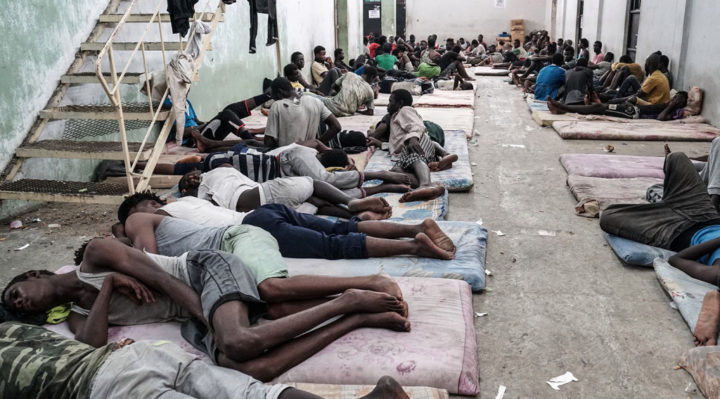
Migrants at a detention center in Zawiyah, west of Tripoli, on June 17, 2017. TAHA JAWASHI/AFP/Getty Images
Norway is considering taking in 600 refugees and asylum seekers from Libya, who are currently at the emergency transit center in Bugesera District, Rwanda.
This is part of plans from the Scandinavian country to halt the smuggling of migrants from the Mediterranean Sea.
Confirming the news, Norway’s Justice and Immigration Minister Joaran Kallmyr in a statement to The Associated Press, said: “For me, it is important to send a signal that we will not back smuggling routes and cynical backers, but instead bring in people with protection needs in an organized form.”
“Therefore, the government has decided to collect 600 quota refugees from Libya, out of 800 in total, from the transit reception in Rwanda in 2020,” he added.
Migrants are left to die in Libya_Photo: Foreign Policy
Somalia, Eritrea, and Sudan contribute largely to the number of refugees on the continent. According to UNHCR, 2019, 150,000 – 200,000 migrants left the East and Horn of Africa (EHoA) region traveling eastwards towards the Arab Peninsula and northwards towards northern Africa and Europe.
Norway isn’t the only country in Europe which has taken steps to resettle refugees. In 2017, the French government absorbed a group of 19 Sudanese refugees, 11 of them children, most of whom were selected from a refugee camp in Chad.
Meanwhile, Rwanda’s Foreign Affairs Minister Dr Vincent Biruta at his first media briefing said that his country is hosting about 300 refugees and asylum seekers of different nationalities at the Gashora Transit Centre.
Since 2015, the number of migrants risking their lives to enter into European Union territories increased as the regional body continues to find ways to stop refugees and other migrants from crossing the Mediterranean.
As part of an agreement signed between Rwanda, the African Union and the United Nations refugee agency in September, the East African country hosts a camp for people who have been evacuated from often chaotic, overcrowded detention centers in Libya.
Article 2 of the European Union’s main treaty proclaims that the EU “is founded on the values of respect for human dignity, freedom, democracy, equality, the rule of law, and respect for human rights.”
“These values are common to the member states,” the document states.
But earlier this month, Norway — which is not an EU member but guarantees human rights in its constitution — granted temporary political asylum to Polish human rights activist Rafal Gawel, his wife, and their small daughter. Oslo agreed with his contention that Poland’s populist government had significantly eroded the independence of the country’s judiciary.
“I simply showed that at the moment in Poland most of the courts have been taken over by politically empowered persons,” Gawel told to media in a telephone interview from Oslo. “Therefore, we cannot say that there is an independent judiciary in Poland, independent of executive-branch and government influence.”
Rafal Gawel stands in his office in Warsaw, shortly after it was raided in February 2017 by the police, who seized computers.
Gawel, 47, is the founder and head of the Center for Monitoring Racist and Xenophobic Behavior in the eastern Polish city of Bialystok. In January 2019, he was sentenced to two years in prison after being convicted of fraud, forging signatures, and faking financial documents. He denies the allegations and says his conviction was political persecution for his center’s activity exposing far-right extremism.
Gawel, who also cited threats from far-right groups that he says have contacts with Poland’s ruling Law and Justice (PiS) party in his asylum application, is the first Pole to be granted political asylum in the West since Poland joined the EU in 2004 — and in fact, since the end of communist rule and the Cold War 15 years earlier.
The nationalist-populist PiS took over the Polish government in 2015 and has been accused of dismantling the country’s democratic institutions and of promoting right-wing extremism.
“Slowly, slowly, Poland is moving toward [being] a fundamentalist, Catholic country,” Gawel asserted. “The worst thing is that Polish populists…have noticed that it is a huge advantage to frighten people and consolidate their voters around fear…. Every few years PiS changes the narrative a little and pushes its followers to fear homosexuals or refugees or Muslims.”
Alarm bells over the PiS’s judicial reforms have been sounding since at least 2015. According to a European Commission report last month on the state of the rule of law in the bloc, the reforms “have increased the influence of the executive and legislative powers over the justice system and therefore weakened judicial independence.”
‘Fundamentally Deviating Interpretation’
Similar concerns have been voiced for years over Hungary under Prime Minister Viktor Orban and his nationalist Fidesz party. Hungary was downgraded to “partly free” on the Freedom In The World index issued by the U.S.-based NGO Freedom House. It accused the Fidesz government of instituting “policies that hamper the operations of opposition groups, journalists, universities, and nongovernmental organizations…whose perspectives it finds unfavorable.”
In 2019, the respected Central European University, partially funded by Hungarian-born billionaire George Soros, withdrew most of its activities from Hungary following a two-year campaign against it by the Fidesz government. The EU, the U.S. government, and academic institutions around the world denounced Budapest’s actions as an assault on academic freedom.
Roland Freudenstein, policy director of the Brussels-based Martens Centre, which is associated with the center-right European People’s Party, said Poland and Hungary presented a unique problem within the European Union because they are endorsing a “fundamentally deviating interpretation” of EU treaties.
“What we have in [these] two countries, we now have a fundamentally deviating interpretation of the treaties,” he told RFE/RL. “And it is extremely hard to mend this and to come back to a unified interpretation of the treaties with the political parties that are in power in those two countries.”
Poland and Hungary, Freudenstein said, “claim that rule of law is based on national traditions and that there is no genuinely valid European definition of the rule of law.”
“That’s the root of the problems we have in the European Union at the moment,” he added.
Sophie Pornschlegel, a political scientist with the European Policy Center, another Brussels-based think tank, noted that although the Gawel case involved non-EU member Norway, there have been examples of EU members Germany and the Netherlands declining to extradite Polish nationals using similar arguments.
“They don’t trust the justice system there, which is a huge issue because it is the basis of European cooperation to have mutual trust in the justice system, not only for citizens, but, of course, also for the single market,” Pornschlegel told RFE/RL.
She added that the fact that the union works on the basis of unanimity makes it difficult to confront members on questions of fundamental values.
“One of the big issues I see is that European values are seen as a political or policy field like any other policy field, without realizing that these are the fundamental values we base our cooperation on,” she said. “There should be a difference there in how you treat those issues compared to economic policy, climate change policy…. When those values are not respected anymore, then we have a real issue which goes beyond the kind of daily political interests and differences we may have.”
Real Change ‘Must Come Locally’
Stefan Lehne, a visiting scholar with Carnegie Europe, is more sanguine about the situation, although he acknowledges that the EU has “a big problem in quite a number of countries, specifically in Hungary and Poland.”
However, he said, the recent European Commission report on the rule of law found “there are problems in just about every member state.”
“There is nothing like a place where the rule of law is freely flourishing,” he told RFE/RL.
Lehne argues that the European Court of Justice may be the bloc’s best mechanism for rebuilding its values consensus, and said that the court had “become a little bit more active” in taking on rule-of-law matters.
“Both in the case of Hungary and Poland, there have been a number of judgements recently which ultimately have been implemented by the governments and led to changes,” he said.
Ultimately, however, he pins his hopes on Hungarian and Polish citizens, noting that Fidesz has suffered losses in recent municipal elections. “Similarly, in Poland, change is possible and the civil society in both places is alive,” he told RFE/RL. “It’s an uphill struggle and it will take some time, but fundamental change only comes locally.”
Gawel, who has vowed to continue his monitoring of the far right in Poland from Oslo, expressed similar hopes for Poland. “Poles are in general outspoken supporters of the European Union,” he said. “We, as a nation, have always valued the achievements of the West and Western civilization. We have always aspired to belong to it.”
“Everything will depend on whether democratic forces will be able to gain a voice in Poland or whether the PiS will continue to rule,” he concluded.
In the meantime, he has three cases against the Polish government currently pending in the European Court of Human Rights.
The Norwegian Nobel Committee has decided to award the Nobel Peace Prize for 2020 to the World Food Programme (WFP) for its efforts to combat hunger, for its contribution to bettering conditions for peace in conflict-affected areas and for acting as a driving force in efforts to prevent the use of hunger as a weapon.
The escalating conflict has worsened the famine threat in South Sudan’s Equatoria regions as thousands of farmers and families are forced to abandon their homes, according to the Norwegian Refugee Council (NRC).
In a statement on Monday, NRC said the killing of civilians has also disrupted planting for farmers at a time when 60% of the population is suffering from acute food insecurity.
NRC called on all parties to the conflict to urgently resolve tensions and avoid accelerating the risk of famine.
“Civilians have been killed and displaced due to fresh violence over the last month, exacerbating a genuine famine threat as farmers and families are forced to abandon their homes.
“All parties should end the violence and allow unfettered access to aid organizations, otherwise we risk witnessing a humanitarian crisis not seen in the country for years,” said Mark Millar, Policy Analyst for NRC in South Sudan.
Truck drivers from neighboring countries are unable to deliver supplies and humanitarian workers are unable to provide aid due to fighting in the war-torn country, NRC said, adding that at least 1,500 people have sought shelter in the town of Yei.
Many South Sudanese remain trapped in the bush and thousands are believed to have fled into neighboring Uganda, according to NRC. Founded in July 2011, South Sudan has been hit by years of conflict.
Despite glimmers of hope following the signing of a peace agreement in 2018, conflict, violence and displacement are again becoming a day-to-day reality in South Sudan.
In March, the country’s government began a series of security operations against the National Salvation Front (NAS) rebel group in the southern part of Central Equatoria State.
Around 235,000 people are currently displaced in Central Equatoria and the number looks set to increase as conflict continues. Approximately 50,000 people are displaced in Eastern Equatoria, according to NRC.
EU defence ministers on Thursday (6 May) agreed to allow the United States, Norway and Canada to join the bloc’s project on military mobility, seen as the ‘silver bullet’ for EU-NATO defence cooperation and designed to ensure seamless movement of military equipment across the EU in response to crises.
“Their expertise will contribute to the project and, with it, to improving military mobility within and beyond the EU,” the bloc’s foreign policy chief and meeting chairman, Josep Borrell, said following the agreement.
“It will make EU defence more efficient and contribute to strengthening our security,” he added.
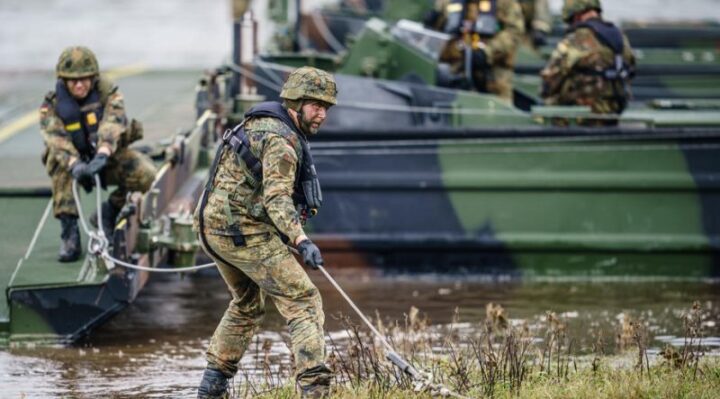
Soldiers pull a ropes as they practices the crossing of the river Elbe at the crossing point between Storkau (Elbe) and Hohengoehren, in Hohengoehren, Germany, 23 October 2020. [EPA-EFE/CLEMENS BILAN]
It’s the first time that the EU will allow outside countries to join its so-called Permanent Structured Cooperation (PESCO) framework of 46 military projects and is a sign of improving EU-NATO cooperation.
Formally established in December 2017, the PESCO framework was created with the intention to deepen defence cooperation among the 25 participating EU member states, help fund, develop and deploy armed forces together and make the EU’s defence sector more flexible and independent of the US.
It does not amount to a joint military force, but some EU members have raised fears of duplication and solo-runs.
Military mobility aims at improving the exchange of information between EU countries and cutting red tape at borders, including harmonising customs rules to allow for swift deployments and easier transport of military equipment, diplomats said.
More than 70,000 US military personnel are stationed in Europe, partly to help reassure Estonia, Latvia, Lithuania and Poland that they will be defended in case of aggression from Russia.
Canada is currently leading a NATO battlegroup stationed in the region, while Norway is considered as the key to security in Northern Europe, and especially the Arctic region.
With the decision, the three countries will join the Dutch-led project aimed at easing bureaucratic procedures that slow troop deployments considerably, whether by land, sea or air.
“We are very pleased (…) to welcome three important NATO countries to this EU project. I will send the official invitation letters soon,” Dutch Defence Minister Ank Bijleveld said in a statement.
“Currently, there are administrative and infrastructural barriers that make it difficult for military personnel and equipment to move through Europe. Often, it is easier for a tourist to travel through the EU than it is for military personnel,” she added.
The EU has designated €1.7 billion over the next seven years to help bolster the bloc’s military mobility” including by upgrading infrastructure like bridges, rail and roads.
A new dimension of the EU’s current Trans-European Transport Network (TEN-T) policy addresses the implementation and development of a Europe-wide network of railway lines, roads, inland waterways, maritime shipping routes, ports, airports and railroad terminals.
Dual-use (civilian-military) co-funding of transport infrastructure projects has also been proposed within the next Connecting Europe Facility (CEF).
“We need standardisation as much for civil projects that fulfil military requirements as for the latter themselves,” Jörg Vollmer, commander of NATO’s Joint Force Command Brunssum, urged in March.
German Defence Minister Annegret Kramp-Karrenbauer described the move as “a quantum jump in our concrete cooperation.”
She said bringing the countries in is “an enormous step regarding the practical ability of the European armed forces. And we see this as another big step regarding trans-Atlantic connectivity and in the cooperation of EU and NATO.”
“The EU’s road to developing a stronger, more sovereign, more united and more strategic defence and security policy must reinforce and under no circumstance undermine transatlantic cooperation and NATO,” MEP David McAllister, head of the European Parliament’s foreign affairs committee told EURACTIV.
“As the example of military mobility shows, it is possible to build up meaningful structures in the EU framework and pave the way for stronger and more ambitious defence cooperation with partners,” he added.
More members to come?
While there have been no specific talks with Britain, which along with France was one of the EU’s biggest military powers, more foreign countries can seek to join, diplomats say.
“It is also very important for transatlantic cooperation, good cooperation between EU members and NATO allies,” said one of the diplomats, who spoke under condition of anonymity.
Under the deal, brokered by the German EU presidency, a third country can only apply if it meets a stringent set of political, legal, and “substantive” conditions.
The political conditions for third countries limit their participation to cases where they provide “substantial added value” to the military project and share “the values on which the EU is founded”, meaning that they do not contravene its security and defence interests.
Many EU diplomats agree that the set of political conditions effectively excludes Russia, China, and Turkey.
A certain outsider
As EURACTIV reported in November, NATO member and EU candidate Turkey is likely to remain outside the PESCO framework, at least until the dispute with Cyprus over activities in Eastern Mediterranean is resolved and tensions in the standoff with Greece and France are defused.
The EU has kept Ankara at arm’s length from its initiatives although Turkey, with one of the largest militaries in Europe, has been an associate member of the Western European Union (WEU) and its Armaments Agency (European Defence Agency predecessor). It is also a member of NATO and participates in the Organisation for Joint Armament Cooperation.
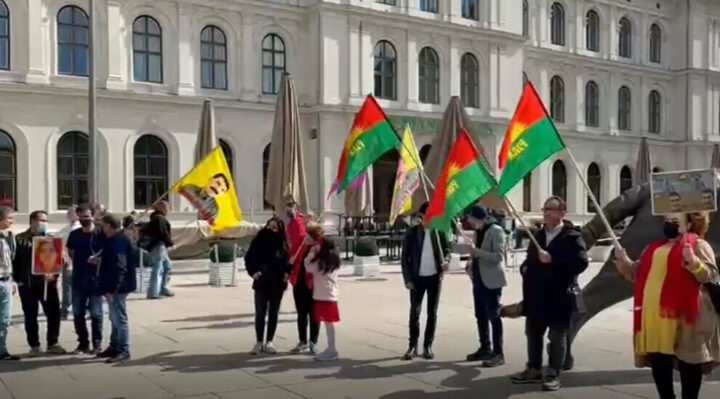
The attacks of the invading Turkish state against Kurdistan and the executions carried out in Iran were protested in Oslo.
The action organized by NCDK Oslo and PJAK begun in front of Oslo’s central station with a minute silence.
The messages of PJAK and KJAR followed music and songs by artist Welat Kobanê.
The speeches made at the event paid tribute to four revolutionaries Shirin Elemhuli, Ferzad Kemanger, Eli Heyderiyan and Ferhad Wekili who were executed by Iran on May 9, 2010.
“9 May is a day against free thinking for the freedom movement in Eastern Kurdistan. On this day, 11 years ago, the dictatorial reactionary state in Iran has executed four Kurdish resistance fighters and revolutionaries without trial. Ferzad Kemanger, Shirin Elemhuli, Eli Heyderiyan, Ferhad Wekili became the symbol of the struggle against dictatorship. This struggle and their resistance will remain in the memories of the Kurds and these martyrs will never be forgotten. We commemorate the prison martyrs and May martyrs. We promise to continue their struggle.”
Activists also protested the Turkish state’s invasion attacks against South Kurdistan and sen this message “It is time for the unity and solidarity of the Kurds against these attacks”.
Norwegian activists from Anti Rasist and Solidaritet med Kurdistan also spoke at the demonstration.
StormGeo, a Bergen, Norway-based provider of weather intelligence and advanced data science solutions, announced that it was acquired by Alfa Laval from Sweden.
The deal was made in cash for a price consideration of NOK 3.63 bn ($440M), on debt free basis. StormGeo will become a part of the Alfa Laval Marine Division.
StormGeo, founded in 1997 and led by CEO Søren Andersen, has its origin in TV2, Norway’s largest commercial broadcaster, which in 1993 was the first to use animated weather reports. Meteorologist Siri Kalvig saw an opportunity to offer customized weather services to other industries. This idea eventually grew into StormGeo.
The company now employs 515 people in 15 countries and provides solutions and services for weather-sensitive operations, primarily in the marine industry, off-shore and other weather-dependent industries. The company’s weather information services help customers mitigate risk, improve safety and make sustainable choices on routes and operations.
StormGeo has since 2014 been under the ownership of EQT, DNV GL and a group of employees. Total sales in 2020 amounted to NOK 714M ($86.5M).
Alfa Laval, led by CEO Tom Erixon, is active in the areas of Energy, Marine, and Food & Water, offering its expertise, products, and service to a wide range of industries in some 100 countries. The company is committed to optimizing processes, creating responsible growth, and driving progress – always going the extra mile to support customers in achieving their business goals and sustainability targets.
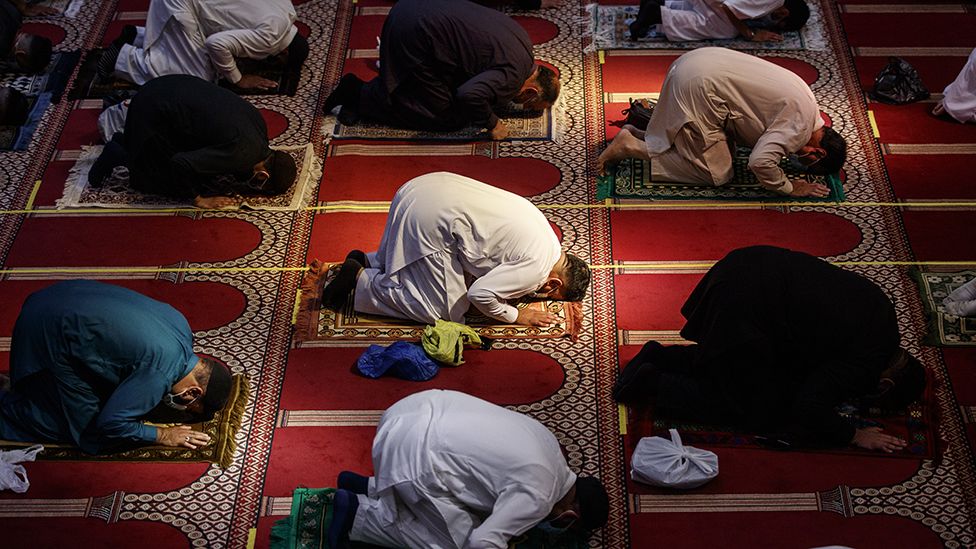
Many Muslims will attend Eid prayers at their mosque, early on 13 May.
In the Middle East, these are held straight after the Fajr morning prayer. In the UK, it’s any time from 07:00 onwards.
It’s a tradition to wear new clothes and on the way to the mosque, eat something sweet such as a date, and recite a small prayer called a takbeer.
Before Eid prayers, Muslims are also required to pay an amount to charity per household called zakaat al fitrana to help feed the poor.
Many Muslims enjoy large meals with friends and family, and exchange money and gifts.
In many Muslim countries, Eid al-Fitr is a public holiday.
What impact will lockdown have?
Lockdown restrictions are due to be eased in England from Monday 17 May, but the government has said there will be no early exemption for Eid.
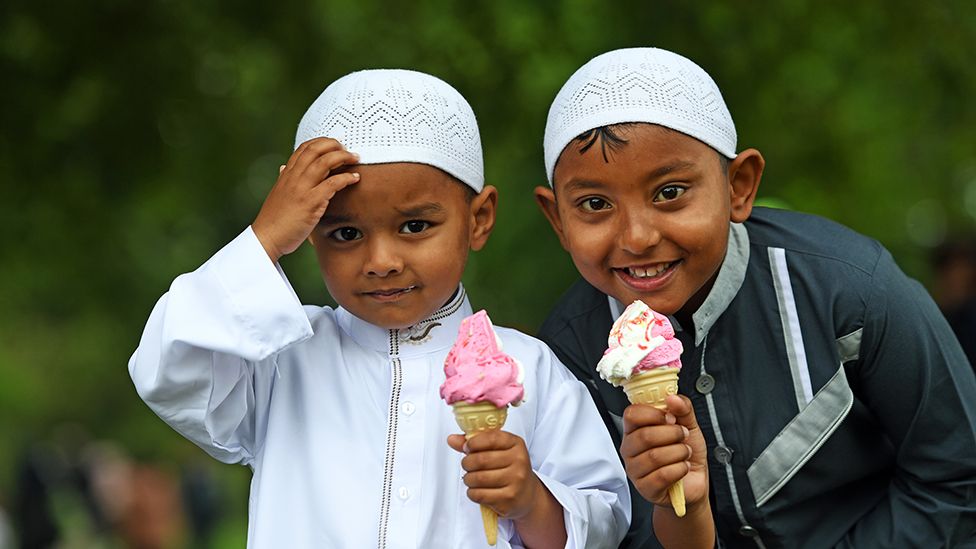
image captionCelebrating Eid in Birmingham, 2019
What is Ramadan?
Ramadan is the Arabic name for the ninth month in the Islamic calendar.
It is considered one of the holiest Islamic months.
It’s also one of the Five Pillars of Islam. These are five principles which Muslims believe are compulsory acts ordered by God.
Muslims believe that some of the first verses of the Islamic holy book, the Qu’ran, were revealed to the Prophet Muhammad during the month of Ramadan. Extra emphasis is placed on reciting the Qu’ran at this time.
Fasting is considered to be an act of worship, which enables Muslims to feel closer to God and strengthen their spiritual health and self-discipline.
How does this work in practice?
Muslims have an early morning meal before dawn, known as suhoor or sehri.
They break their fast after sunset for the evening meal, called iftar or fitoor.
Ramadan is also a time when Muslims are encouraged to give to charity, strengthen their relationship with God, and show kindness and patience.
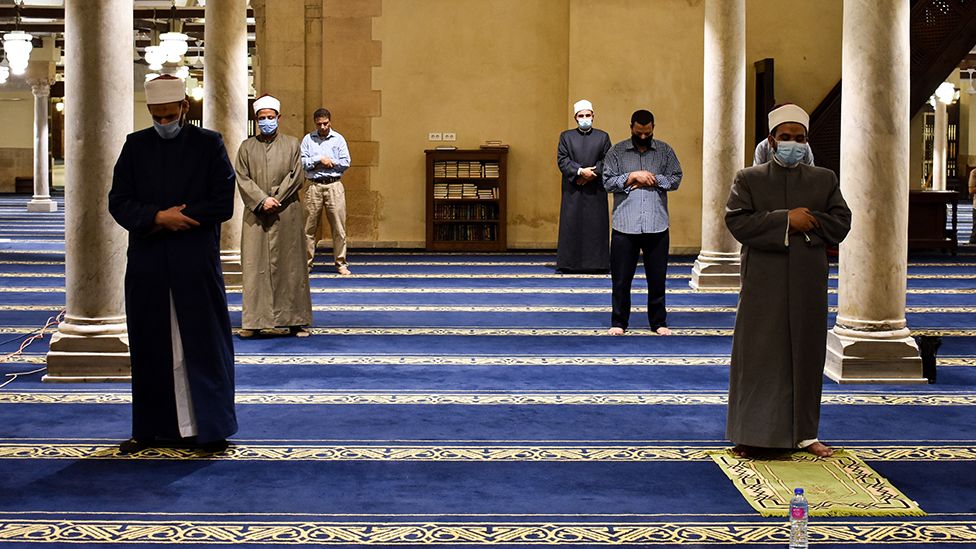
During the month, believers also head to the mosque for an additional night prayer called Taraweeh. This is only held during Ramadan.
image captionSocially distanced Taraweeh prayers at a mosque in Cairo
How has Ramadan been different this year?
This is the second Ramadan to have fallen during the coronavirus pandemic.
For Muslims in the UK, just like fellow believers around the world, this has meant another year of changes to traditional practices.
The iftar meal is usually shared with family and friends. Because of the lockdown, such meetings have been restricted once more.
However, while mixing between households was banned during Ramadan in 2020, this year the festival has coincided with the easing of some lockdown rules in England.
Up to six people or two households can currently gather outdoors or in a private garden. Restaurants are also able to serve meals outdoors.
For those who have been unable to meet, many virtual iftar events and online Islamic lectures have taken place.
image captionA small iftar meal in London, 2020 – lockdown has made large gatherings impossible
What else has changed?
Another change from 2020 is that mosques have been open throughout the UK, and able to host Taraweeh prayers in the evening.
Mosques in England are asking worshippers to wear a face covering, bring their own prayer mat, and socially distance.
Many mosques have also reduced the length of prayers to minimise the time spent in congregation.
The Islamic calendar follows the lunar calendar of 12 months.
The month of Ramadan is the ninth of the year, and Eid is celebrated at the beginning of the 10th month, Shawwal.
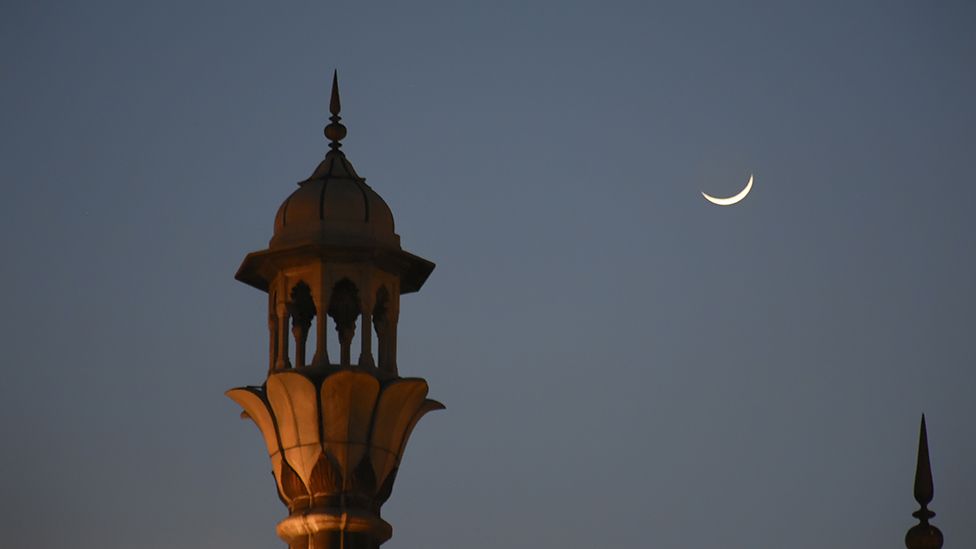
Each month begins with the sighting of the new crescent moon and lasts either 29 or 30 days.
In the past, this was done by the naked eye, but in recent years, telescopes and technology have been used.
image captionThe beginning of Ramadan last year in Delhi, India
Muslim countries are spread across a large geographical area, from Indonesia to Morocco, meaning that some Muslims may see the new moon earlier than others.
“Traditionally, Makkah [Mecca in Saudi Arabia] was the centre of sighting the moon,” says Prof Muhammad Abdel Haleem from the Centre of Islamic Studies at London’s SOAS (School of Oriental and African Studies).
“Sometimes even in the Middle East, neighbouring countries will say they’ve seen the moon on different days,” he says.
The lunar calendar is about 10 days shorter than the Western calendar. which means that each year Ramadan starts about 10 days earlier.
Fasting should only be done by people who are in good health.
Some Muslims are exempt:
Those who are sick or ill and whose health will be affected by fasting
Children – although some may begin to practise fasting from a young age
Pregnant and breastfeeding women
Menstruating women
Travellers
What’s Eid al-Adha?
Although Eid al-Fitr has become a well-known event in the UK, this is not the only Eid celebration in the Islamic calendar.
Eid al-Adha is celebrated during the month of Dhul-Hijjah. This is the month where Muslims from across the world make the pilgrimage to Makkah known as Hajj.
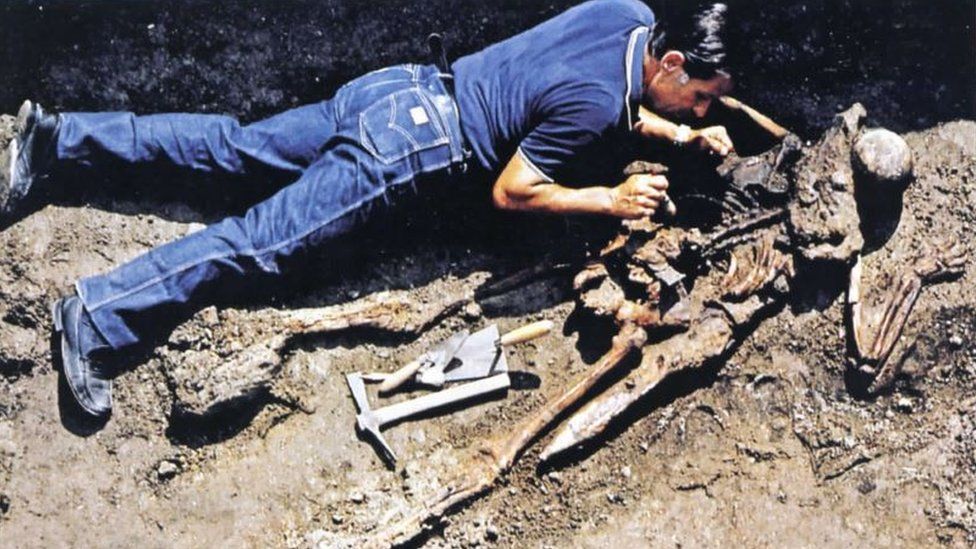
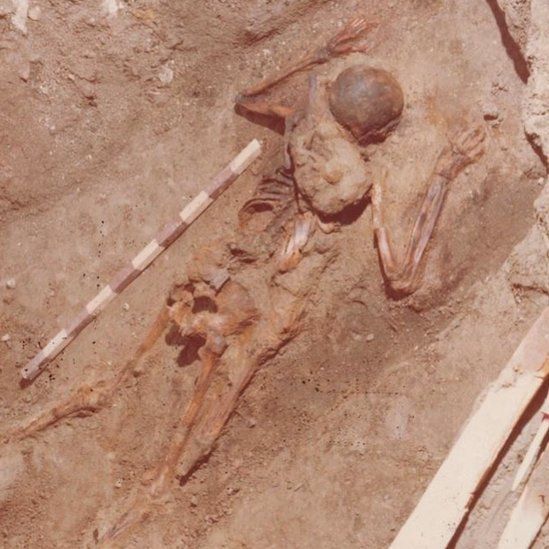
Skeleton no 26, as it is known, is believed to have belonged to man aged between 40 and 45 and in good health, who was thrown to the ground by the force of the eruption. A boat was found nearby and it is now thought that the 300 other skeletons found massed on the beach were close to being rescued.
image captionA bag with tools was found with the skeleton when it was discovered
Francesco Sirano, the director of the archaeological site at Herculaneum, said the items discovered with the skeleton no. 26 suggest he may have played a more important role than originally thought.
“He may be an officer of the fleet that took part in the rescue mission launched by Pliny the Elder to help the people in the towns and villas nestled on this part of the Bay of Naples,” Mr Sirano told Ansa news agency.
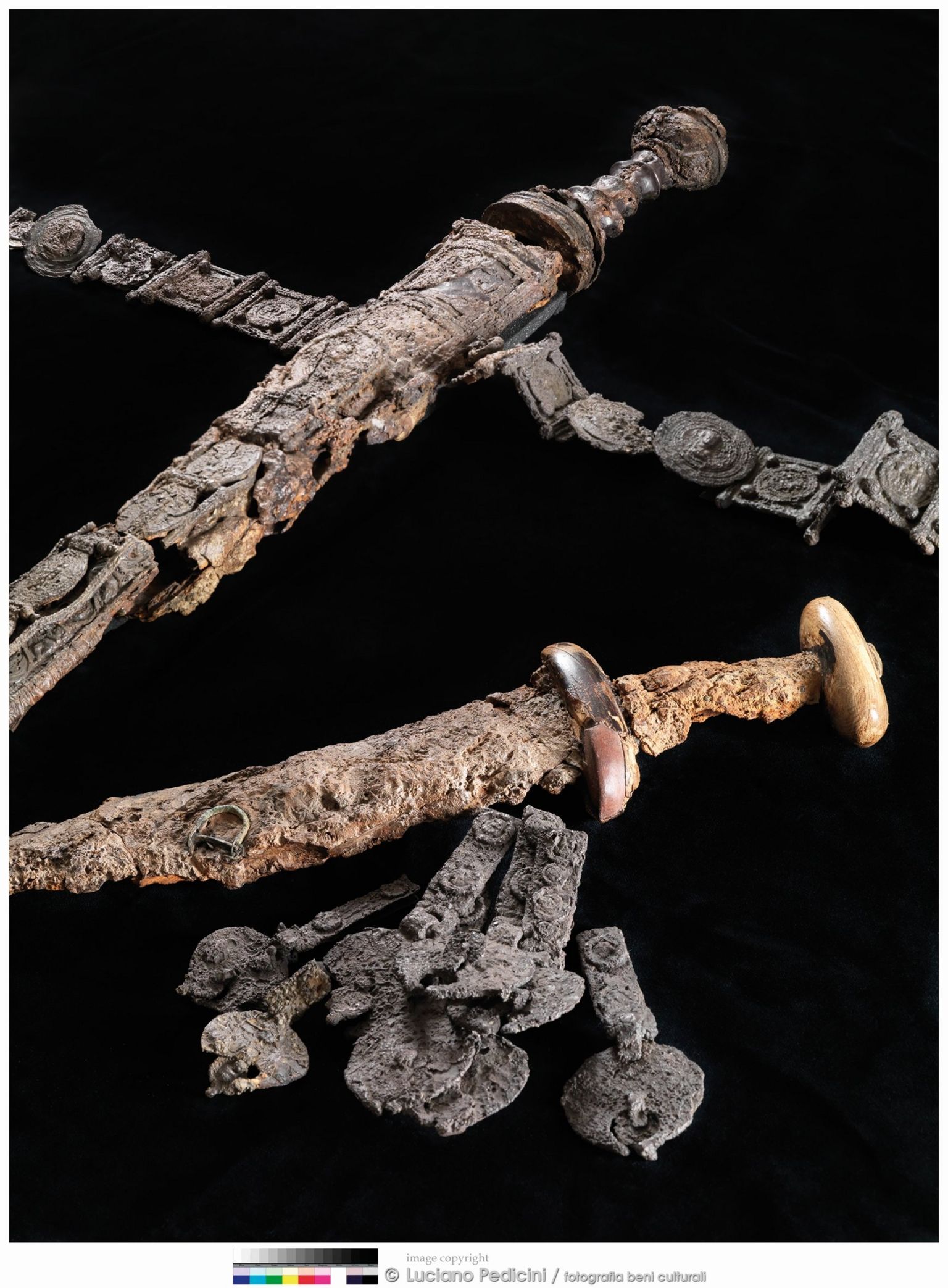
Twelve silver and two gold denarii coins were found in the man’s possession – the equivalent of a month’s salary for members of the elite Praetorian Guard, according to Mr Sirano.
His highly decorated gold and silver belt and a sword with an ivory handle indicate he was no ordinary soldier, while his bag contained tools likely to have been used by a faber navalis – one of the Guard’s naval engineers specialised in carpentry.
Pliny the Elder was a Roman naval commander stationed at the port of Misenum, further up the coast from Herculaneum. He was himself well known for writing about natural history. His death during the eruption of Vesuvius was recorded by his nephew, Pliny the Younger, in two letters written to the historian Tacitus.
“The ash already falling became hotter and thicker as the ships approached the coast. It was soon followed by bits of pumice and blackened, burnt stones charred by the fire… [my uncle] wondered for a moment whether to turn back, as the captain advised, but he decided instead to go on.”
Excavations at the site are expected to resume in the coming weeks.



 The Norwegian Nobel Committee has decided to award the Nobel Peace Prize for 2020 to the World Food Programme (WFP) for its efforts to combat hunger, for its contribution to bettering conditions for peace in conflict-affected areas and for acting as a driving force in efforts to prevent the use of hunger as a weapon.
 by
by 



 Sports Newz